
Our commitment
Organic farming
No herbicides, no synthetic chemical inputs, hand-picked harvest. And 18 Kunekune pigs that tend the vineyard.
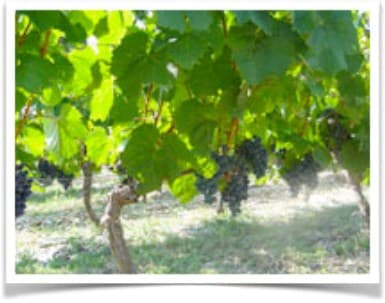
Clos de Pougette is certified in organic farming — both vineyard and cellar. The certification, achieved after several years of conversion, frames everything we do: no herbicides, no synthetic fertilisers, no chemical fungicides, no systemic insecticides, no winemaking additives forbidden under organic rules.
But certification is only a frame. Our daily practice often goes further than the spec — out of consistency, out of conviction, and because work is better when you love it.
No herbicides, no chemical inputs
Vegetation between rows is not fought with chemicals: it's managed mechanically (claws, discs, ploughshares) and, on certain plots, by our 18 Kunekune pigs (more on that below). The fungicides we use are the only ones permitted under organic farming — copper and sulphur, in measured doses adapted to seasonal pressure.
In the cellar, fermentation often runs on indigenous yeasts when the vintage allows; sulphites are limited; no technological additives. The goal: a wine that reflects its grapes, with no chemical middleman.
Our 18 Kunekune pigs tend the vineyard
It has become the visual signature of the estate — and it's also a strong agronomic stance. Our 18 Kunekune pigs tend the vineyard by grazing between the rows.
Why the Kunekune breed?
The Kunekune is a breed from New Zealand (the name means "fat and round" in Maori). Three features make it an ideal partner for a vineyard:
- Small adult size (50 to 80 kg, vs 200-300 kg for a standard domestic pig) — they don't compact the soil and don't damage the rows.
- Grazers, not rooters — unlike most pig breeds, Kunekune eat grass at the surface rather than digging up the soil for roots. Vine roots are preserved.
- Very gentle temperament, social, low-stress — easy to handle daily and to keep alongside visitors and the estate's other animals.
It's a rare breed in France, even rarer in vineyards. Our herd counts 18 individuals rotated between plots according to the season and the vines' needs.
What they bring concretely
Our 18 Kunekune:
- naturally limit weed growth through regular grazing;
- fertilise the soil through their droppings, rich in organic nitrogen;
- gently turn over the topsoil as they walk and root around;
- reduce tractor passes, and therefore diesel use and soil compaction;
- broaden the biodiversity of the plot (insects, birds following the pigs, and so on).
This is not a fad. It's a coherent alternative to energy-intensive mechanical weeding and to chemical weeding (which is forbidden in organics). The trade-off: it requires more time on site and more supervision than simple mechanisation. That's the price for this kind of stewardship.
→ See our pigs in action on Instagram (videos below).
Hand-picking and sorting
Every cuvée at the estate is hand-harvested. This lets us:
- pick each plot at its optimal ripeness, with multiple passes if needed;
- sort the fruit at the source, leaving behind damaged, oxidised or under-ripe bunches;
- respect the grapes (no mechanical bruising before they reach the cellar).
It's slower and more expensive than machine-harvesting. But on a 22-hectare human-scale farm, it's possible — and it's the foundation of a clean wine.
Organic vs conventional wine — a comparison
| Criterion | Organic (our approach) | Conventional |
|---|---|---|
| Herbicides | Forbidden | Often used |
| Synthetic fertilisers | Forbidden | Commonly used |
| Fungicides | Copper and sulphur only | All approved fungicides |
| Systemic insecticides | Forbidden | Allowed |
| Yeasts | Indigenous or organic | Industrially selected |
| Sulphites | Limited, often reduced | Limited to AOC ceiling |
| Cellar additives | Tightly restricted list | Broader list |
| Certification | Yes (AB / EU leaf label) | None specific |
Frequently asked questions
Are all Clos de Pougette wines organic? Yes. The entire estate is certified in organic farming. That includes our AOC Cahors (Tradition, Clos de Pougette, Hauts de Pougette), our Côtes du Lot IGP (rosé, white), our Bag-in-Box, the Ratafia and the grape juice.
How do our 18 Kunekune pigs help tend the vineyard? Our 18 Kunekune pigs (a New Zealand breed, small and grass-grazing) browse between the rows, naturally curb weed growth and fertilise the soil. They don't root the soil and don't compact it (50-80 kg each), so they preserve vine roots and soil structure. That cuts tractor fuel use and limits ground passes. They are kept off the plots during sensitive periods for the vines.
Which copper do you use, and at what dose? Copper is used only when downy mildew pressure demands it, in measured doses, always under the annual ceiling permitted in organics. We favour modern low-dose formulations.
Why not biodynamic? Biodynamic farming adds, on top of organic rules, practices tied to a lunar calendar and specific preparations. We apply some of the principles (plant-based preparations, attention to seasonal rhythms) without having, to date, sought biodynamic certification. The discussion is open.
Does organic taste different? Organic doesn't have a taste of its own — it produces a different grape: more in balance with its environment, often tighter, more salivating. Then it's the cellar work that gives the wine its taste. The winemaker's talent is to let the grape speak without distorting it.
Do the pigs eat the grapes? They're moved off the plot before veraison (the moment when berries start to ripen), so they're not tempted by the fruit. Kunekune are naturally grazers — they prefer grass over fruit anyway.
Why specifically the Kunekune breed? Originally from New Zealand, Kunekune are small pigs (50-80 kg adult) with a gentle temperament that browse grass at the surface without rooting the soil. Three essential qualities in a vineyard: no soil compaction, no damage to vine roots, no stress for the herd around humans and visitors.