
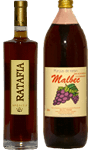
Alongside Cognac and Armagnac in South-West France, there is a quieter, almost forgotten product, and yet a beautiful one: ratafia. At Clos de Pougette we have been making it for decades, out of fidelity to a Quercy tradition that deserves a second life.
What exactly is ratafia?
Ratafia is what œnology calls a mistelle: a blend of fresh non-fermented grape juice and eau-de-vie, in defined proportions. The alcohol interrupts fermentation and preserves the natural sugar of the grape. Result: a roughly 17° drink, sweet, round, fragrant — halfway between wine and liqueur.
In Quercy, the eau-de-vie used is traditionally a pomace eau-de-vie — distilled from the grape residues (skins, pips) after pressing. That's what gives Quercy ratafia its more rustic character compared to Pineau des Charentes (Cognac) or Floc de Gascogne (Armagnac).
A long history
The word ratafia probably comes from the Latin rata fiat — "let it be ratified" — used to seal an agreement, traditionally with a glass. In the Middle Ages and Renaissance, ratafia was widespread across European wine-growing Europe: each family made it from grapes, fruits, or plants, to its own recipe.
In the 19th and 20th centuries, the industrialisation of apéritifs (port, vermouth, pastis) pushed back artisan ratafias. Today, they survive only in a few estates that produce them by tradition — like ours.
How we make it
At every harvest, we take a small quantity of fresh, healthy grape juice, immediately after pressing. That juice is muted with our pomace eau-de-vie in a proportion that brings the mix to about 17% alcohol. The whole rests several months in vat before bottling. No aggressive filtration, no chemical stabilisation. Just time at work. Simple, generous, winemaker's.
How to drink it
As an apéritif
Well chilled, around 8–10 °C, in a small glass. Neat or on a few cubes. It pairs well with toasts of foie gras, cheese gougères, or salted almonds.
With foie gras
A South-West classic, in our taste more interesting than with Sauternes: the ratafia's fruit anchors better in the foie's fat.
With dessert
Ratafia + pear tart, ratafia + strawberries with pepper, ratafia + clafoutis. It plays the role of a liqueur but with more matter and less apparent sweetness.
In cocktails
Modern bartenders are rediscovering it. A simple suggestion: Ratafia + tonic + orange peel on ice. Fresh, slightly bitter, surprising.
Cellaring
Unlike wine, ratafia keeps very well opened: the alcohol stabilises the product. Refrigerated, several months without loss. Closed bottle, years if kept away from light.
In cooking
A few culinary uses: deglaze a pan of duck breast or game; flavour pastry cream or chocolate mousse; marinate dried fruit (prunes, figs) for foie gras or cheese; sweeten a compote, jam, or syrup. A versatile product.
Why it's rare today
Making ratafia means time (vinification, rest, separate bottling), grapes (taken out of the main flow), and a know-how few young winemakers carry. Modern economic logic pushes a wine estate to focus on wine. Ratafia survives among those who do it out of fidelity, not calculation.
In short
If you don't know ratafia, you'll discover an authentic, fruity, surprisingly versatile winemaker's apéritif. If you already know it, you know it's one of the South-West's quiet treasures. Our Quercy Ratafia sells at €16 a 75 cl bottle — our way of keeping a tradition alive.