
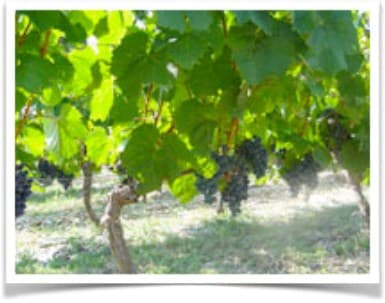
Malbec built its global fame in Argentina, in Mendoza's high valley. Yet it was born in France — more precisely in South-West France, around Cahors, where it has been called Auxerrois or Côt for centuries. And it's in Cahors that it gives, in our view, its most singular expression: not the rounded Argentinian fruit, nor the lighter Bordeaux-blend version, but dense, mineral, deep wines that the Middle Ages already called black wines.
One grape, two worlds
Genetically, Argentinian Malbec and Cahors Malbec are the same variety. A Frenchman, the agronomist Michel Aimé Pouget, brought it to Argentina in 1853, just as phylloxera was wiping out the French vineyards. But between high Andean altitude (1,000 m and above, dry, intensely sunny) and the Lot causses (200–300 m, temperate oceanic climate, limestone soils), the result in the glass is almost unrelated.
Argentinian Malbec often produces generous, round, fruity wines, rich in alcohol (14–15°), with a soft tannic sweetness. Cahors Malbec produces wines that are tighter, more mineral, more "black", with masculine tannins, a limestone backbone, and a longer cellaring potential. It's not a quality question — it's an identity question.
The causses terroir
What makes Cahors Malbec singular is the limestone plateau it grows on. Shallow, free-draining, stony soils stress the vine. And a stressed vine concentrates: small berries, thick skins, dense juice, high phenolic load. The result: that almost-black colour, those powerful tannins, that mineral grain that signs Cahors.
On deeper red clay soils, Malbec gives fleshier, rounder, more immediate wines — what we use in our Tradition cuvées. On pure causse limestone, time is needed: our Hauts de Pougette cuvées ask for 5 to 10 years before opening fully.
Black wine, then and now
In the 13th and 14th centuries, Cahors wines were celebrated across Europe. Served at the English court, exported via Bordeaux all the way to Northern Europe, they were so dense they were called black wines. Pope John XXII (born in Cahors) had them shipped up to Avignon. Peter the Great of Russia, healed after surgery, attributed his recovery to a Cahors and made it the wine of Orthodox Mass.
That dense, dark, deep identity faded in the 20th century, when yields rose and wines were vinified lighter for fast-drinking markets. For the past twenty years, a generation of winemakers has worked to recover the original character of Cahors — by hand-harvesting, longer macerations, careful ageing, and increasingly, organic conversion. We are part of that movement.
How to recognise a great Cahors Malbec
A few markers in the glass:
- Colour: very dark, almost opaque, purple or tile-red reflections depending on age.
- Nose: black fruits (mulberry, blackcurrant, plum), violet, liquorice, graphite, sometimes truffle on older vintages.
- Palate: ample attack, powerful but not drying tannins, long finish with a menthol or mineral return.
- Cellaring: 5 to 15 years depending on the cuvée, sometimes more.
To explore that identity, taste our Hauts de Pougette 2021 (oak-aged), or our Clos de Pougette 2022 for a more immediate read.
Our position
We believe Cahors Malbec deserves more visibility than it currently has. Most casual drinkers still associate Malbec with Argentina. Our work, as Cahors winemakers, is to make wines that remind people — without nostalgia or provincialism — that this grape was born here, on these limestone causses, and that it gives its most mineral, most tense, most authentic version here.
Cahors isn't another Malbec among many. It's the Malbec of its place of origin. That's what we put in the bottle in Cournou, since 1880.